Locked out of your car in Delaware County or Philadelphia? Learn the safe steps to take, what professional locksmiths do to unlock your vehicle without damage, and how to prevent future lockouts.

First things first: don’t panic. Your brain wants to jump straight to breaking a window or trying to pry the door open with whatever’s nearby. Don’t.
Take a breath. You have time to handle this the right way.
Check every door and the trunk. Sometimes one door didn’t fully latch, or you left the trunk unlocked. It takes thirty seconds and might save you a service call. Look for any windows that might be cracked open enough to reach through, but don’t force anything.
Before you call anyone, think about where your spare key is. If you’re close to home and someone can bring it to you, that’s your easiest fix. Some people keep a spare with a trusted neighbor, family member, or in a magnetic box under the car (though that last one’s not great for security).
If you have a newer vehicle, check whether you set up your manufacturer’s app. Many cars from the last several years—Honda, Toyota, Ford, Chevy, Hyundai, Nissan, Subaru—offer apps that let you unlock your doors remotely from your phone. You need to have paired the app with your car before the lockout happens, but if you did, you can unlock your car in seconds without calling anyone.
No spare nearby and no app? That’s when you need a professional.
Don’t try to unlock it yourself unless you really know what you’re doing. Those YouTube videos showing coat hangers and slim jims make it look simple. It’s not. Modern cars have airbag sensors, electronic wiring, and weather stripping that’s easy to damage. One wrong move and you’re looking at repair bills that cost way more than a locksmith. Plus, if you scratch your paint or crack your window trying to force entry, your insurance might not cover it.
If there’s an emergency—like a child or pet locked inside on a hot day—call 911 immediately. Otherwise, your next call should be to a mobile locksmith who can come to you.
You should call a locksmith when you’ve checked all the doors, you don’t have a spare key within reach, and you’re not in immediate danger. A professional mobile locksmith will come to wherever you are—parking lot, driveway, side of the road—and unlock your car on the spot.
In Delaware County and Philadelphia, response times are usually 20 to 30 minutes. That’s faster than waiting for a tow truck and way cheaper than having your car towed to a dealership. An emergency car locksmith can handle just about any vehicle lockout situation: keys locked inside, dead key fob, broken key stuck in the door, or a smart key system that stopped responding.
Auto locksmiths who specialize in automotive work carry tools designed specifically for car locks. We know how to work with older manual locks and newer keyless entry systems. We won’t damage your car, and most jobs are done in minutes once we arrive.
When you call, be ready to tell us your location, the make and model of your car, and what happened. If your key fob isn’t working, mention that. If your keys are visible inside the car, let us know. The more information we have, the better prepared we’ll be when we show up.
Cost is usually somewhere between $50 and $250 depending on the complexity of your lock, the time of day, and your location. It’s a good idea to ask for a quote over the phone so there are no surprises. We’ll give you an upfront price before we start work.
One more thing: if you have roadside assistance through your insurance or AAA, check your coverage. Some plans include lockout service, though you might still need to pay out of pocket if you’ve used your annual limit or if the service takes longer than expected. Even with coverage, calling a local locksmith directly is often faster.
Want live answers?
Connect with a McCausland Lock Service expert for fast, friendly support.
You might wonder how a locksmith gets your car open without breaking anything. It’s not magic, but it does take training and the right tools.
Professional auto locksmiths don’t use coat hangers or crowbars. We use specialized equipment designed to unlock vehicles safely, and we choose the method based on your car’s make, model, and lock type. The goal is always the same: get you back in without scratching paint, cracking glass, or triggering your airbags.
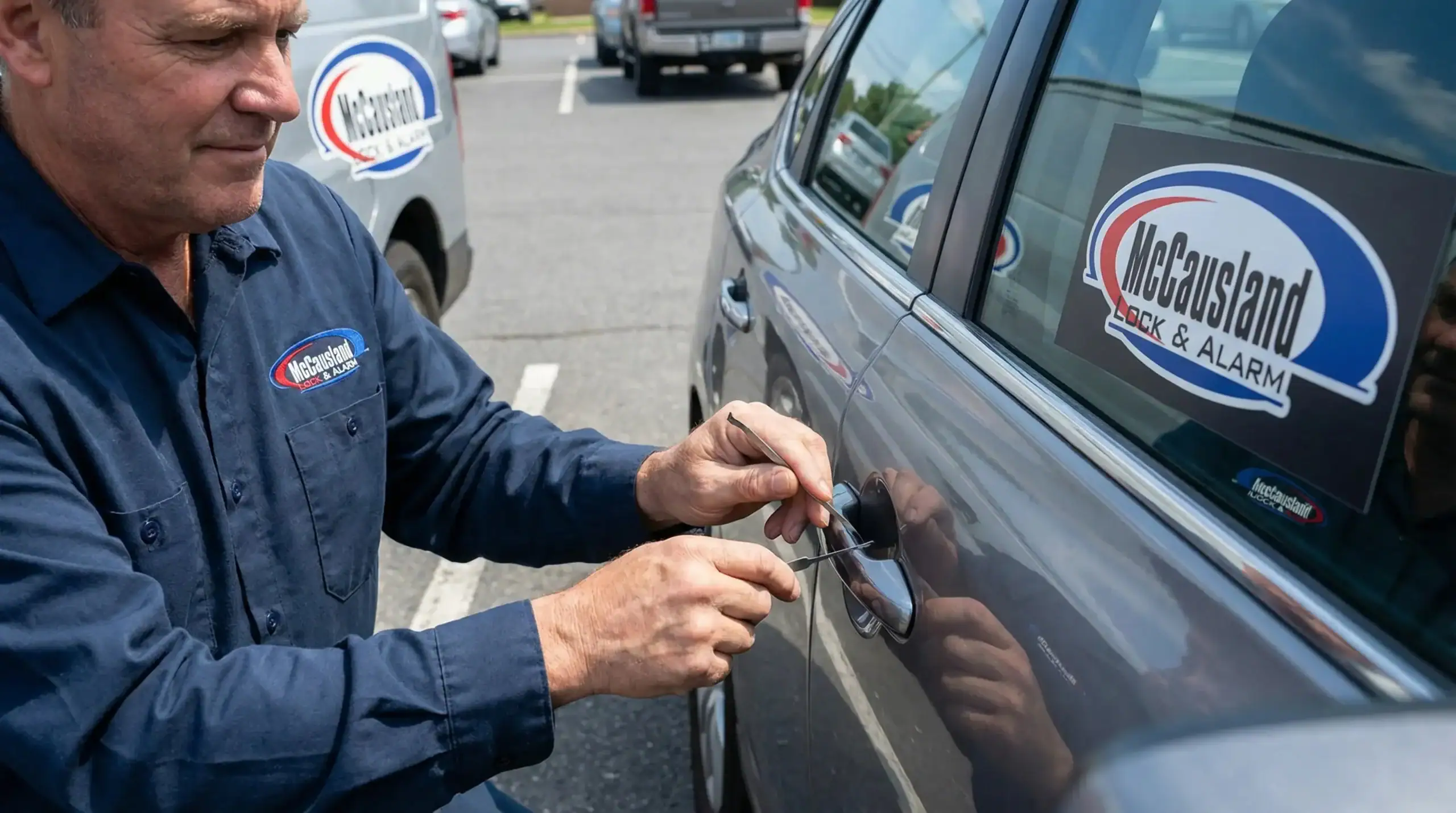
For older cars with manual locks, locksmiths often use a tool called a slim jim. It’s a thin, flat piece of metal that slides between the window and the weather stripping to reach the lock mechanism inside the door. It looks simple, but using it correctly requires knowing exactly where the lock rods are and how to manipulate them without damaging wiring or triggering side airbags. That’s why professionals can do it in minutes while DIY attempts usually end badly.
If your car has power locks or a button near the window, we might use a wedge and long-reach tool. We’ll carefully insert an air wedge or plastic wedge into the door frame to create a small gap—just enough to slide a long rod through. That rod is used to press the unlock button or pull the door handle from inside. The wedge protects your paint and door seals, and the whole process is non-destructive when done right.
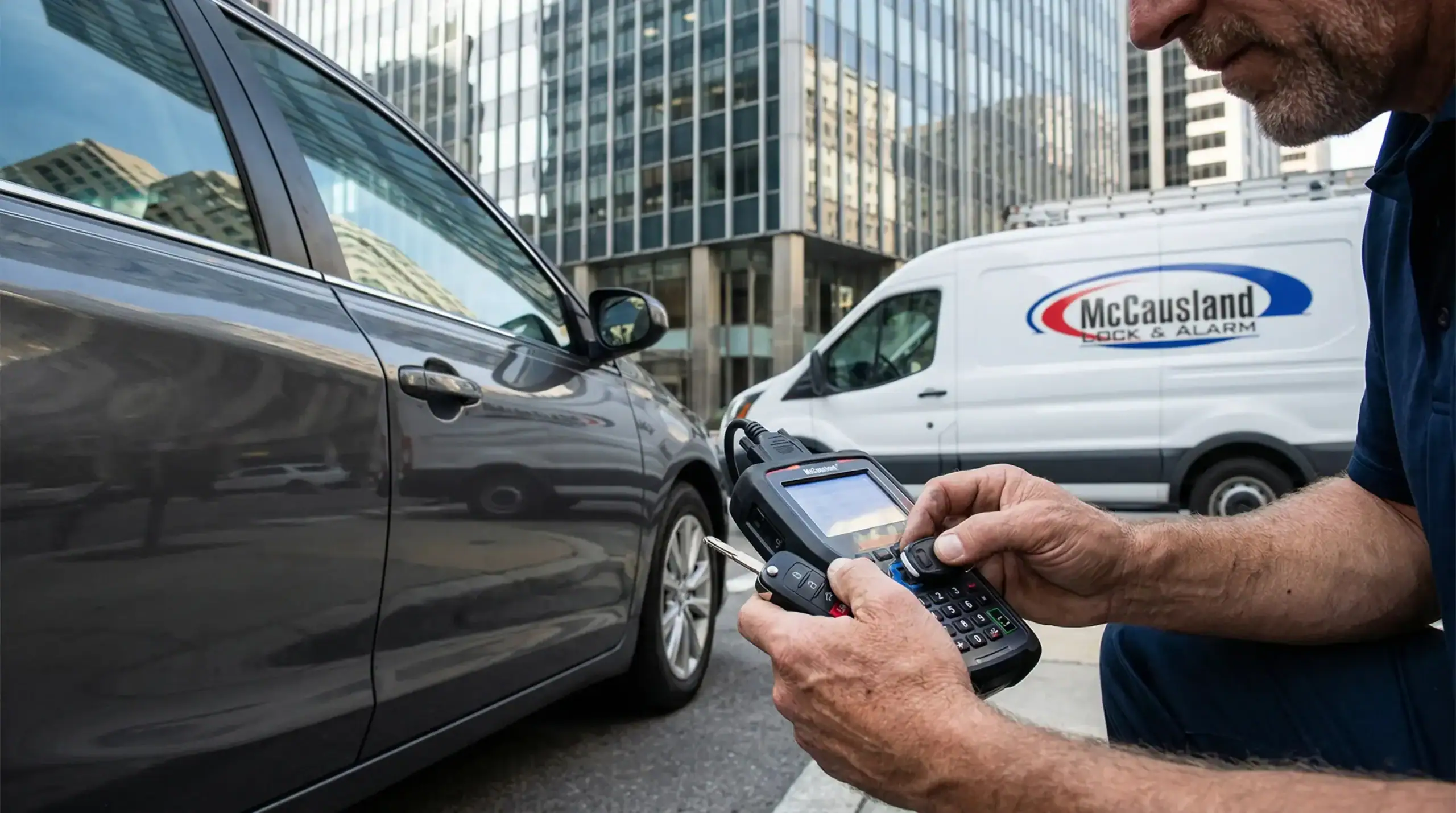
For newer cars with keyless entry, the approach is different. These systems rely on electronic signals between your key fob and the car’s computer. If your fob battery is dead or the system isn’t recognizing the signal, we can use diagnostic tools and software to reprogram or reset the system. We can also cut and program new transponder keys on-site if your key is lost or broken.
Some vehicles have an immobilizer system—a theft deterrent that prevents the car from starting if it doesn’t detect the right key. If that system malfunctions, it can lock you out even if you have the key. We know how to diagnose and fix immobilizer issues without causing further problems.
J tools and L tools are used on specific older car models where the lock button is positioned in a certain way. These are shaped differently to reach through the window gap and lift the unlock button. Not every car needs these, but we have them in our kit just in case.
The bottom line? Professional car lockout service means your vehicle stays intact while you get back inside fast.
It’s tempting to try to save money by unlocking your car yourself, especially if you’re watching videos that make it look easy. But here’s the reality: modern cars are complicated, and one mistake can cost you way more than a locksmith would have.
If you use a coat hanger or homemade tool and slip, you can scratch your window, tear your weather stripping, or damage the rubber seals around your door. Water leaks and wind noise are expensive to fix. If you pry the door too hard, you might bend the frame or crack the paint. And if you hit the wrong wire or sensor inside the door, you could trigger the airbags or disable your power locks completely.
Even on older cars, the lock mechanisms are more delicate than they look. Forcing a tool into the wrong spot can break internal components, which means you’ll need to replace the entire lock assembly. That’s a much bigger job than just unlocking the door.
Then there’s the time factor. Most people spend 20 to 30 minutes struggling with DIY methods, get frustrated, and end up calling a locksmith anyway. By that point, you’ve wasted time, you’re more stressed, and you might have caused damage that makes the locksmith’s job harder.
Professional locksmiths do this every day. We’ve seen every type of lock, every car model, and every lockout scenario. We know which method works for which car, and we have the tools to do it quickly and safely. The cost of hiring a pro is almost always less than the cost of fixing the damage you’d cause trying to do it yourself.
If you’re in an emergency situation—like extreme heat with a child or pet inside—breaking a window might be necessary. But for a standard lockout, patience and a phone call will save you money and hassle.
Once you’re back in your car, take a few steps to make sure this doesn’t happen again. Get a spare key made and keep it somewhere accessible—at home, with a family member, or in your wallet if it’s a flat emergency key. Many newer cars have a physical key hidden inside the fob that you can use to manually unlock the door even if the battery dies.
Check your key fob battery regularly. Most last about 12 to 18 months, and if yours is getting weak, replace it before it fails completely. It’s a cheap fix that prevents a bigger headache later.
If your car has a manufacturer app, download it and set it up now. Pair it with your vehicle so you have a backup way to unlock your doors remotely. It takes five minutes and could save you from a lockout down the road.
Consider keeping the contact information of a reliable local locksmith saved. When you’re standing outside your locked car, the last thing you want to do is search for help. Having a trusted contact saved ahead of time means you can get help fast without scrambling. We’ve been helping drivers across Delaware County, PA and Philadelphia County, PA for over 140 years, and we’re available when you need us most.
Summary:
Article details:
Share: